


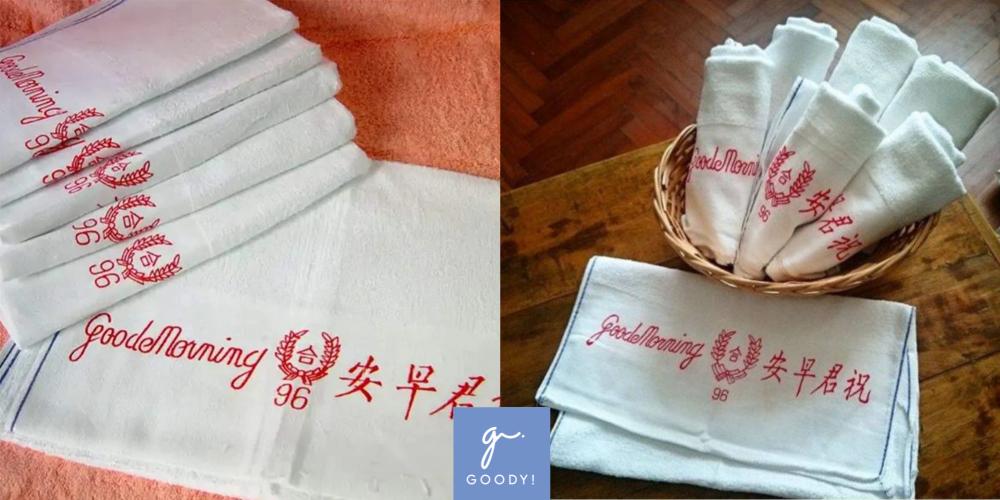

You've probably seen one hanging in a kitchen, kopitiam, workshop, or your grandparents' home. The iconic red, white, and blue checked towel with the words "Good Morning" printed across it has been a familiar sight across Malaysia for generations.
But have you ever wondered where it came from?
Despite being one of Asia's most recognisable household items, the Good Morning Towel has a surprisingly fascinating history that stretches back more than a century.
Where Did The Good Morning Towel Come From?
The truth is, nobody knows its exact origin for certain.
Historians generally trace the towel's beginnings to either late 19th-century Hong Kong or Shanghai, where it became widely used in tea shops, noodle houses, and other businesses.
One theory suggests that the towel first gained popularity in Hong Kong, where workers relied on it to wipe away sweat in the region's hot and humid climate. Another points to Shanghai-based manufacturers that helped distribute and popularise the towel across Asia.
While its exact birthplace remains a mystery, its impact across the region is undeniable.
The Company Behind One Of The Most Popular Versions
One of the most well-known origin stories involves Shanghai's Sanyou Company.
Founded by three friends, the company entered the towel business in 1917 and eventually became one of China's leading domestic towel manufacturers during the National Goods Movement.
As the company expanded, its towels became increasingly popular both within China and throughout Southeast Asia, helping cement the design that many people recognise today.
Why Does It Say "Good Morning"?
Perhaps the towel's most distinctive feature is the phrase "Good Morning" printed across it.
Many historians believe the English greeting was added to appeal to British expatriates living in colonial Hong Kong. During that era, English words were often used on products as a symbol of modernity and international appeal.
However, there is no definitive historical record confirming exactly why the phrase was chosen.
Still, more than a century later, those two simple words remain the towel's signature feature.
And What About "No. 96"?
Another mystery surrounding the towel is the number "96" that often appears alongside the design.
The most widely accepted explanation is that it refers to the towel's size or product specification. Over time, "No. 96" became the most popular version sold throughout the region, eventually becoming part of the towel's identity.
Although various theories exist, no official documentation has ever conclusively explained the number's meaning.
How It Spread Across Southeast Asia
By the early 20th century, the Good Morning Towel had spread throughout Malaya, Singapore, Indonesia, and the Philippines.
Its popularity was largely driven by practicality. The towel was affordable, durable, and easy to carry around, making it ideal for everyday use.
For working-class communities, it quickly became an essential item rather than just a household accessory.
Who Commonly Used It?
The Good Morning Towel became closely associated with hardworking individuals from all walks of life.
It was commonly used by:
Rickshaw pullers
Hawkers
Drivers
Mechanics
Barbers
Market vendors
Whether draped over a shoulder, wrapped around the neck, or hanging nearby, the towel became a familiar companion during long hours of work under the tropical sun.
For many people, it eventually evolved into a symbol of resilience, hard work, and everyday life.
Why Has It Survived For More Than A Century?
In an era filled with modern fabrics and branded towels, the Good Morning Towel continues to remain relevant.
That's because it offers several practical advantages:
Lightweight and comfortable
Highly absorbent
Quick drying
Easy to wash
Affordable
Extremely durable
Its simple design and functionality have allowed it to withstand changing trends for generations.
A Lesser-Known Funeral Tradition
Interestingly, many Chinese Malaysians associate the Good Morning Towel with funerals.
In some Chinese communities, towels were traditionally given to mourners accompanying the deceased to cremation or burial. The towels served a practical purpose, allowing participants to wipe away sweat during long funeral processions conducted under Malaysia's hot weather.
For some families, receiving a Good Morning Towel after attending a funeral became a familiar cultural practice passed down through generations.
An Iconic Household Item

Today, hundreds of millions of Good Morning Towels have been sold across Asia.
What began as a practical cloth for workers has evolved into a cultural icon recognised across multiple countries and generations.
More than a century later, it remains one of the region's most recognisable household items and a nostalgic reminder of everyday life for countless Malaysians.
Whether it's hanging in your kitchen, sitting in your car, or tucked away in your grandparents' home, chances are you've come across one before.
So, do you still have a Good Morning Towel at home?